TL;DR
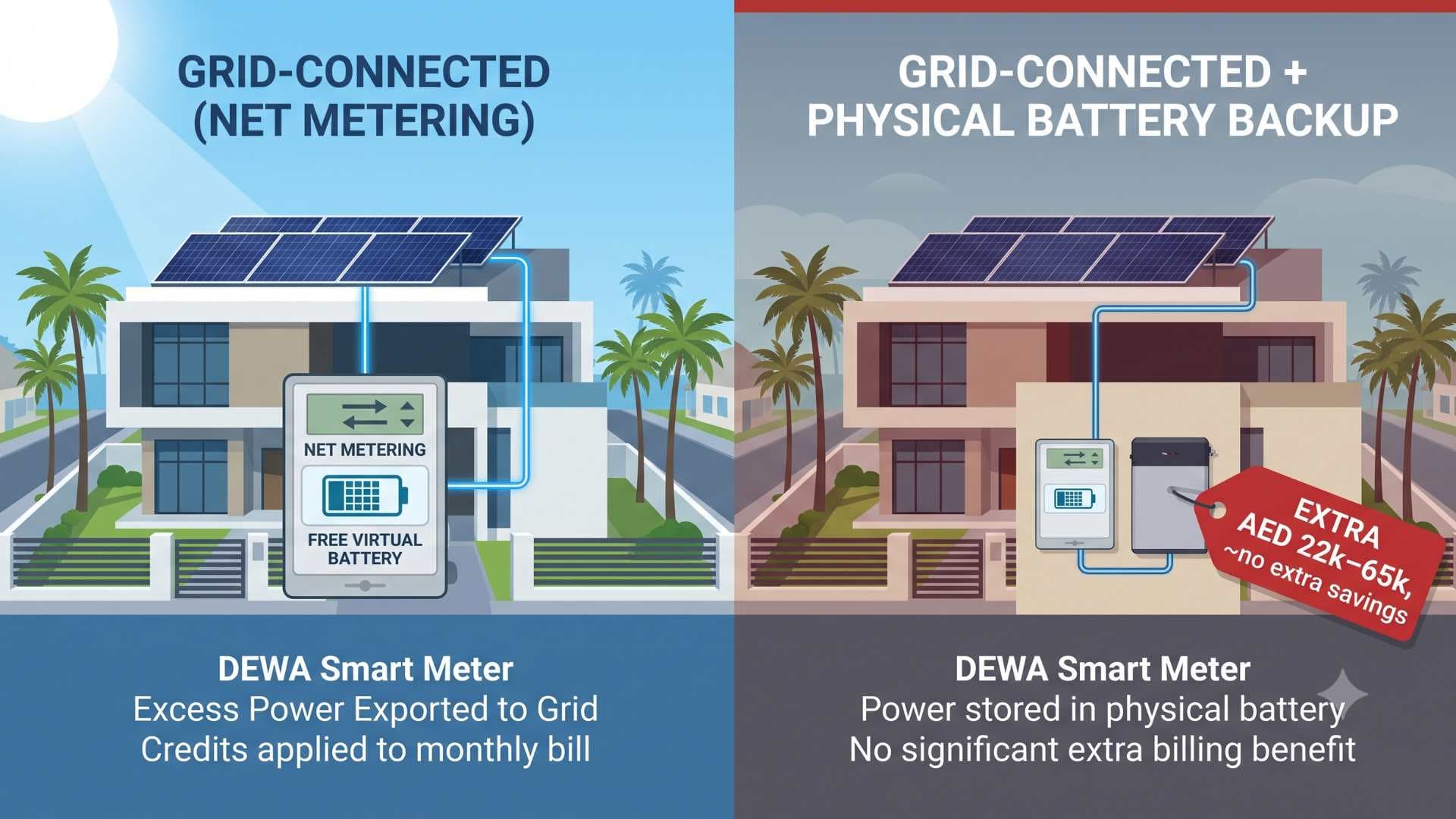
In Dubai, you almost certainly don't need a battery for bill savings. DEWA's Shams Dubai net metering already lets you export surplus by day and draw it back at night — DEWA itself says grid-connected systems "do not require any storage" (DEWA Shams Dubai FAQ).
The grid is your free "virtual battery." Installers describe it exactly that way — "excess daytime generation is exported, then imported back later when the site needs power" (SurgePV).
The three usual battery justifications mostly fail in Dubai: outages are vanishingly rare (DEWA hit a world record of ~49 seconds of outage per customer per year), there's no residential time-of-use tariff to load-shift against, and going off-grid forfeits the net-metering economics that make Dubai solar work.
A battery adds AED 22,000–65,000+ in capex and roughly doubles payback from ~6–9 years to ~12–18+ years — for almost no extra bill savings (market estimates, not verified specs).
Batteries still make sense for backup of critical loads or genuine energy-independence — but not sold to you on "savings" grounds.
The core reason batteries don't pay in Dubai
DEWA's own FAQ is the clearest statement:
"While off-grid PV systems depend on rechargeable batteries to store excess electricity, grid-connected systems do not require any storage, as excess electricity can be fed to the distribution grid. Net-metering programmes provide producers with credit for any electricity they deliver to the grid." (DEWA Shams Dubai FAQ)
In other words, the grid is doing the job a battery would do — for free. Daytime surplus is banked as a kWh credit and drawn back at night. An installer on r/dubai puts the mechanic plainly: "You cannot 'sell' energy to DEWA… DEWA will give you back the same amount of energy when needed (for example at night)" (r/dubai). SurgePV calls the grid a "virtual battery" (SurgePV); Utility Bill UAE frames net metering as "virtual storage at zero cost" (Utility Bill UAE).
The financial logic is brutal and simple: under DEWA's indefinite credit rollover, a battery "does not create additional export credits; it shifts the timing of consumption" — so it's "neutral" on your bill (SurgePV — UAE Battery Storage). You're spending tens of thousands of dirhams to change when you use power you'd have been credited for anyway.
The three reasons people buy batteries — and why they flop in Dubai
1. Backup during outages — Dubai's grid is world-class
Dubai doesn't really have outages. DEWA set a world record for power reliability in 2025, achieving "a new global low of 0.82 minutes, roughly 49 seconds, in Customer Minutes Lost (CML) per year" (Gulf News, April 2026). The Khaleej Times calls the Dubai network "among the world's most reliable."
Paying AED 40,000–80,000 for backup against ~49 seconds of outage a year is a poor trade. Even local guidance acknowledges that "even though blackouts are rare in Dubai, momentary interruptions can still happen" (Imran Khan Technical Service) — but "rare" understates it. The market analysis is blunt: "Battery does NOT make sense if: You live in Dubai/Abu Dhabi with 99.9% grid reliability (0–2 outages/year)" (Utility Bill UAE).
2. Load-shifting against a time-of-use tariff — there isn't one
Batteries earn their keep in markets where peak electricity costs more than off-peak — you charge cheap at night, discharge expensive by day. Dubai doesn't have a residential time-of-use (TOU) tariff. DEWA bills residential customers on consumption slabs, and "you'll still pay the same rate regardless of the time of day you use power" (SETH INT'L). The official DEWA slab tariff has no time-of-day dimension.
No peak/off-peak spread means no arbitrage. A battery has nothing to load-shift against in a Dubai home.
3. Going off-grid — you lose the economics that make Dubai solar work
Off-grid is a real but niche case, and in Dubai it actively hurts you: "Off-grid loses net metering benefits… requires 2–3x larger system investment with 20–30+ year payback… Recommendation: stay grid-connected unless no grid available (extremely remote property)" (Utility Bill UAE). If you're on the DEWA grid, going off-grid means abandoning the free virtual battery to buy an expensive physical one. That's backwards.
What batteries actually cost in Dubai (market estimates)
All figures below are retailer/installer/market estimates from third-party UAE pages — not manufacturer-verified specs, and there is no official Tesla Powerwall UAE retail price (a Dubai installer confirms "Tesla does not publish an official UAE retail price and we do not quote one" — Dubai Smart Home).
Solar + battery systems (installed, UAE, 2026 estimates) — Utility Bill UAE:
5 kW solar + 10 kWh battery: ~AED 45,000–60,000
7 kW solar + 10 kWh battery: ~AED 52,000–70,000
7 kW solar + 13.5 kWh (Tesla Powerwall 2): ~AED 60,000–80,000
10 kW solar + 20 kWh battery: ~AED 90,000–120,000
For comparison, grid-tied without battery: 5 kW ~AED 25,000–32,000; 7 kW ~AED 35,000–45,000 — roughly 40–50% cheaper.
Per-kWh battery cost: ~AED 2,200–3,100/kWh, "adding AED 22,000–62,000 to system costs depending on capacity" (Utility Bill UAE).
Payback impact: grid-tied solar only pays back in ~6–9 years in Dubai; adding a battery stretches that to ~12–18+ years (Utility Bill UAE). The reason is mechanical: a battery captures only ~10–15% extra generation versus net metering, while adding years to payback.
The "50–80 kWh battery" claim — and why it's nonsense for a Dubai villa
You may see forum advice that a Dubai villa needs a 50–80 kWh battery. Here's the source, verbatim:
"For a villa, a minimum of 50 kWh is essential, and ideally, you'd want something in the range of 60 to 80 kWh to ensure better battery health." — r/UAE user (r/UAE, "Solar battery solutions")
This is a single forum opinion, not an engineering spec — the same thread includes jokes about DEWA shutting down "during World War III." It directly contradicts actual installer/vendor sizing guidance, which puts a typical UAE villa battery at:
"10–15 kWh for evening coverage (5 PM to midnight) or 20–25 kWh for full overnight backup with AC" (DEYE MJS — Battery Sizing Guide UAE)
"For a typical UAE villa using 30 kWh/day, a 15–20 kWh battery bank covers overnight needs" (FSolar)
A 50–80 kWh bank is off-grid scale — and in net-metered Dubai, that's exactly the size you don't need, because the grid is already storing your surplus for free.
The honest case for a battery in Dubai
Batteries aren't useless — they're just mis-sold. The genuine reasons to add one, per market analysis and the r/solar community:
Critical loads: medical equipment, a home office/server, or a business that genuinely can't tolerate even a 49-second blip.
Energy independence: you want resilience regardless of economics (a personal priority, not a financial one).
Long-tenure environmental goals: you're holding the property 20+ years and value self-sufficiency.
The r/solar consensus on 1:1 net metering is unforgiving: "generally speaking, no, batteries with 1:1 net metering do not make an ROI… It's really only for backups, but even then a generator is the much, much cheaper option."
If your only goal is backup, a generator is cheaper than a Powerwall. If your only goal is savings, the grid already does the job. A battery sold to you on "savings" grounds in Dubai is largely capex without a savings return.
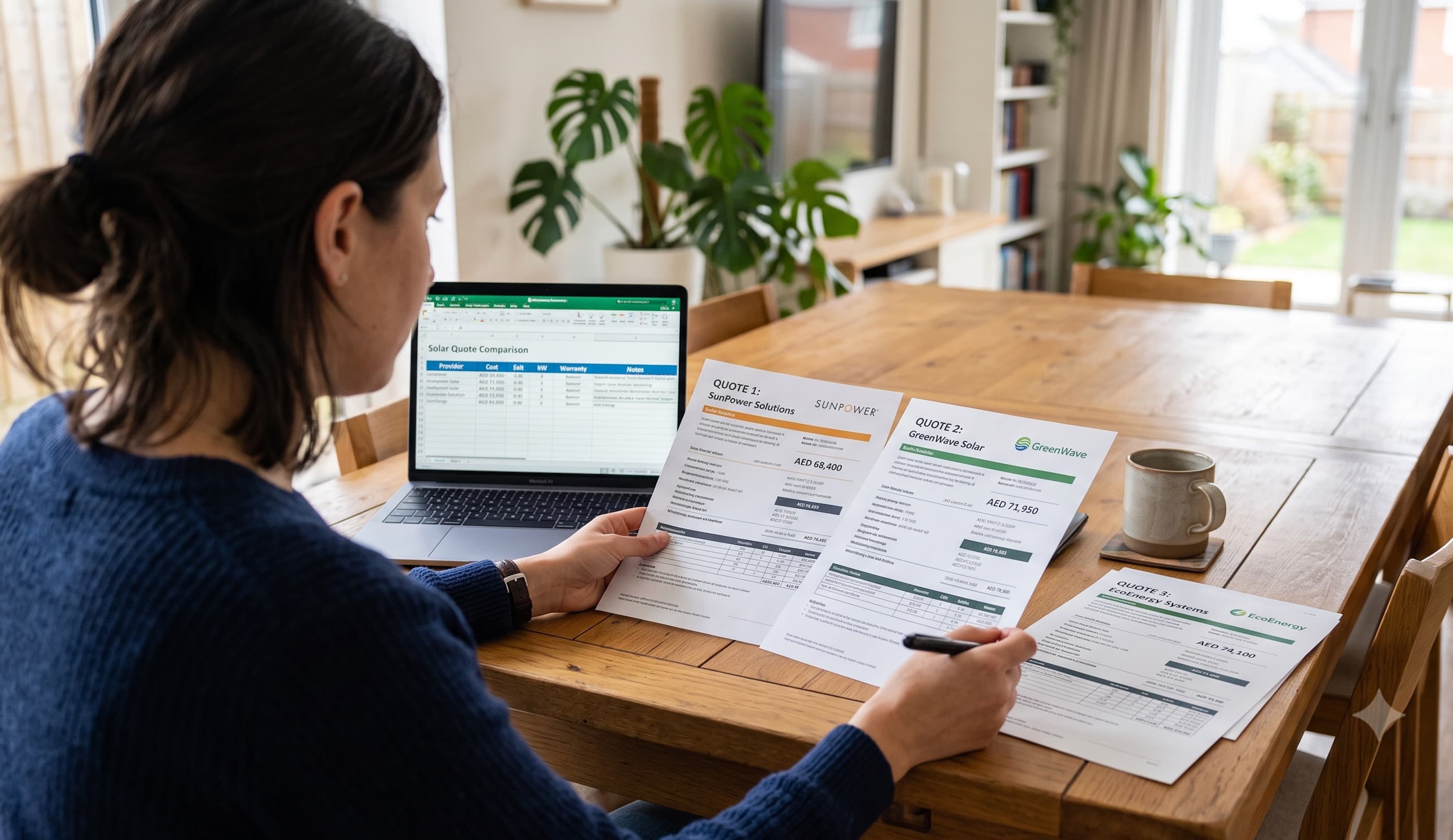
Comparing battery vs. no-battery quotes? Get side-by-side quotes from installers and see the real payback difference — free, no markup. Get your solar quotes →
The bottom line
For most Dubai villa owners, the answer is no — you don't need a battery. DEWA net metering already gives you free virtual storage, the grid is exceptionally reliable, and there's no time-of-use tariff to exploit. A battery only earns its place for genuine backup or independence needs, and it should never be justified on bill-savings grounds. Spend the AED 22,000–65,000 you'd have sunk into storage on a slightly larger PV array instead — in Dubai, more panels earn credits; more battery just shifts them.