TL;DR
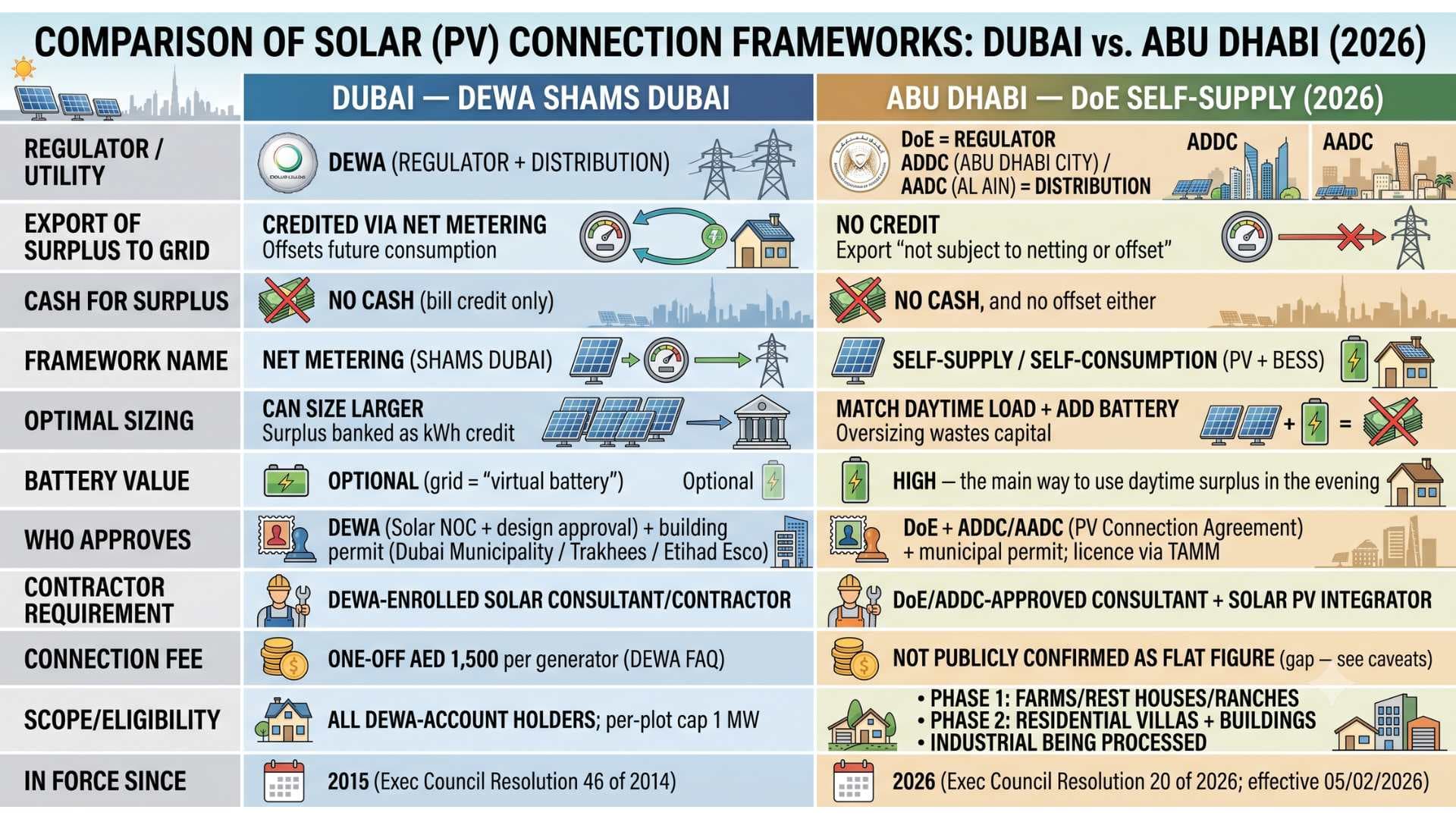
Abu Dhabi does not run net metering. Under the emirate's 2026 Self-Supply Policy, surplus solar exported to the grid is "not subject to netting or offset" and "net metering… is not permitted," according to the Abu Dhabi Department of Energy (DoE Self-Supply Policy).
That changes everything about sizing. In Dubai you can over-produce and bank credits; in Abu Dhabi, unpaid surplus is wasted capital. The right system matches your daytime load, not your roof.
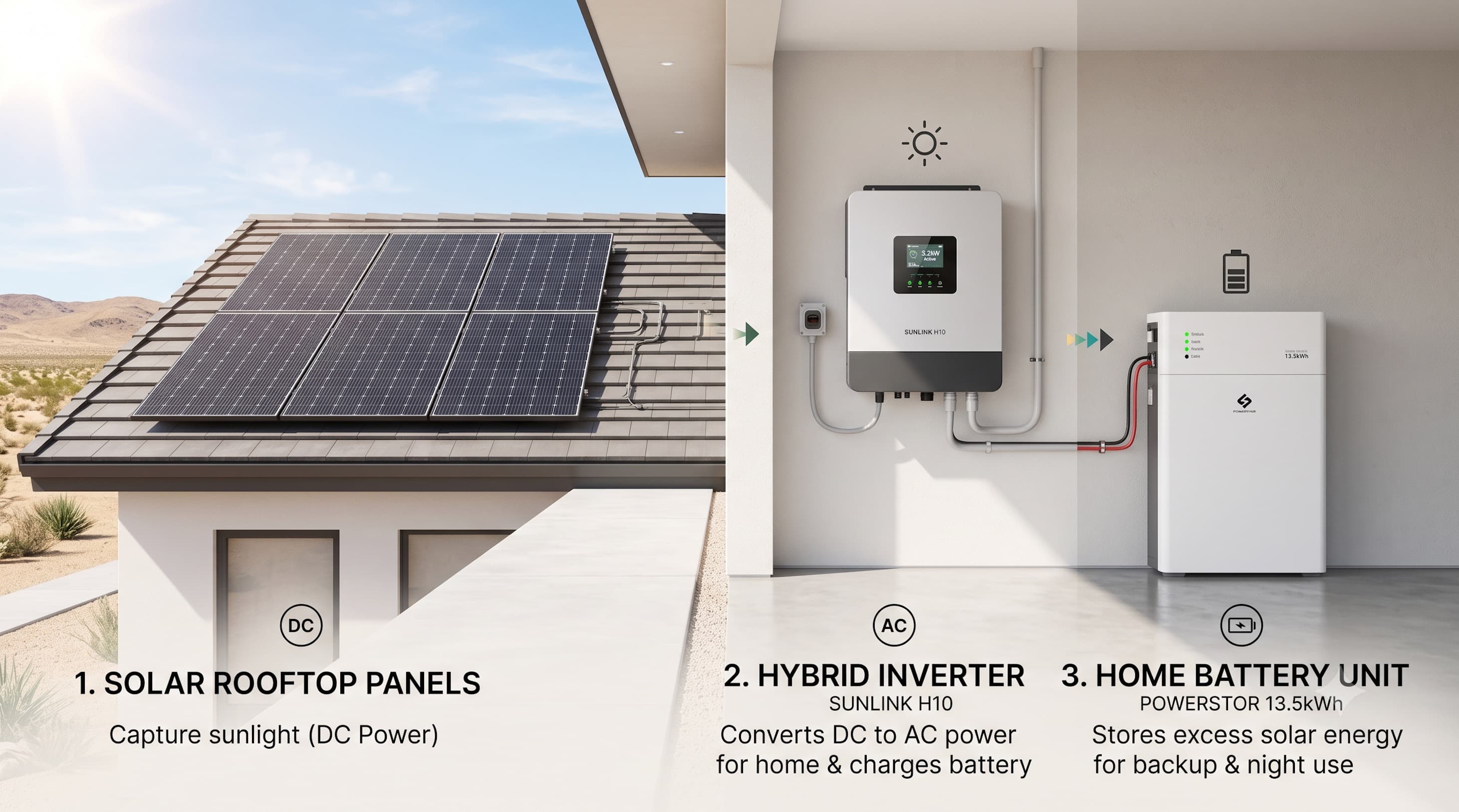
Batteries finally make sense here (unlike Dubai) — storing daytime generation for evening use is the only way to capture energy you'd otherwise give away.
Scope just expanded. Phase 1 (Feb 2026) covered farms, rest houses and ranches; Phase 2 (~March 2026) brought in the residential sector for the first time — villa owners and residential buildings (DoE Phase 2 release).
Never confuse the two regulators. Dubai = DEWA (Shams Dubai). Abu Dhabi = the DoE (regulator) and ADDC/AADC (distribution). They are completely different frameworks.
The one rule that defines Abu Dhabi solar
If you read nothing else, read this. The Abu Dhabi Department of Energy's 2026 policy on the "Use of Solar Photovoltaic and Battery Energy Storage Systems for Self Supply" (effective 05/02/2026) states, in black and white:
"Nothing in this Policy shall be construed as permitting net metering, cross-plot electricity sales, or any form of private wire arrangements unless explicitly authorised by the DoE." (DoE Self-Supply Policy)
And it defines exported electricity as:
"'Export Electricity' means electricity delivered from Self-Supply… to the grid, metered separately from imported electricity and not subject to netting or offset." (DoE Self-Supply Policy)
Abdulaziz Alobaidli, Director General of Regulatory Affairs at the DoE, put it plainly to the Khaleej Times: "At this stage, net metering or energy exports are not permitted under the policy."
Translation: you generate solar, you use it on-site, and anything you push to the grid earns you nothing. No kWh credit. No cash. No offset. This is self-supply — you are producing electricity for yourself, not selling it.
Abu Dhabi-specific quote CTA: Thinking about rooftop solar in Abu Dhabi? The sizing rules here are completely different from Dubai — get quotes from installers who understand self-supply, not net metering. Get Abu Dhabi solar quotes →
Why this trips up everyone (including some installers)
Here's the honest source of the confusion. Abu Dhabi does have an older regulation — the 2017 "Small-Scale Solar PV Energy Netting Regulation" issued by the then-Regulation and Supervision Bureau (RSB, now folded into the DoE) — which did allow a kWh-for-kWh offset of surplus exports (Small-Scale Solar PV Energy Netting Regulations, 2017).
Some industry sources still describe Abu Dhabi as running an "energy netting framework" — but that wording refers to the legacy 2017 regime, not the current 2026 self-supply policy. For self-supply installations, the 2026 DoE policy is the current rule to rely on; legacy netting language should not be used to justify export credits under self-supply. Even under the old 2017 netting regime, no money was ever paid for surplus — only a kWh offset. Either way, the bottom line holds: Abu Dhabi has never paid cash for your exported solar, and from 2026 it doesn't credit it either under the self-supply framework.
If an installer pitches you an Abu Dhabi system on "export credits" or "net metering savings," ask them to show you the current DoE policy text. They are quoting you the wrong rulebook.
The 2026 Self-Supply Policy rollout: what's actually in scope now
The policy is being released in phases, and the scope has moved faster than most commentary online reflects.
Phase 1 — launched February 2026 (agricultural)
Announced at the World Government Summit, Phase 1 opened self-supply to "owners of farms, rest houses and ranches" — segments the DoE says are "particularly well suited to daytime solar generation" (Khaleej Times, 27 Feb 2026). Alobaidli framed it as "regulatory enablement rather than financial incentives," with no subsidies on offer.
Phase 2 — launched ~March 2026 (residential, for the first time)
This is the big one, and the reason this article exists. The DoE's second-phase release confirms:
"The Abu Dhabi Department of Energy (DoE) has announced the launch of the second phase of its Solar Energy Self-Supply Policy, expanding its scope to include the residential sector for the first time in Abu Dhabi. The policy covers villa owners and residential buildings where applicable, enabling them to generate and store electricity from rooftop solar systems…" (DoE Phase 2 release)
The release adds that the new phase focuses on "facilitating adoption through a simplified regulatory framework that streamlines installation and grid connection procedures, alongside the standardisation of technical requirements."
Caveat (as of July 2026): the policy PDF itself states that "the Department of Energy will issue a detailed Guidelines setting out the implementation mechanisms, technical requirements, commercial arrangements, and administrative procedures required to operationalise this Policy." So while residential self-supply is officially enabled, some operational detail (metering, settlement, exact application steps) was still being issued at the time of writing. Treat this as an actively evolving policy — re-verify the latest guideline status before you install.
The sizing logic that decides whether you make money
This is where Abu Dhabi and Dubai diverge most sharply, and where most money gets wasted.
In Dubai's net-metering model, over-sizing is forgivable: surplus gets banked as a kWh credit and rolled forward (see our DEWA credit rollover article). In Abu Dhabi, surplus export earns nothing — so every extra kilowatt of panels that produces energy you can't use on-site is capital spent for zero return.
The DoE's own framing points the right way: Phase 2 "enables customers to meet a significant share of their daily energy consumption during daylight hours and allow them to store electricity through battery storage systems" (DoE Phase 2 release). Note the emphasis: daylight hours and storage.
Industry commentary on the 2026 framework makes the sizing implication explicit: projects will "rely on zero export and self-consumption first," which "leads to sizing projects conservatively to ensure there is no excess production which is being not utilized within the premises itself" (Abu Dhabi 2026 Self-Supply Framework webinar — industry commentary, not official DoE text).
Practical sizing rule for Abu Dhabi: size to your daytime base load — the load that's actually running while the sun is up (AC, pool, daytime appliances, a business's operational equipment). Do not size to your total annual consumption. The goal is maximum self-consumption, minimum export. If you want to use more of your own solar after sunset, add battery capacity rather than more panels.
Why batteries actually matter in Abu Dhabi (and don't in Dubai)
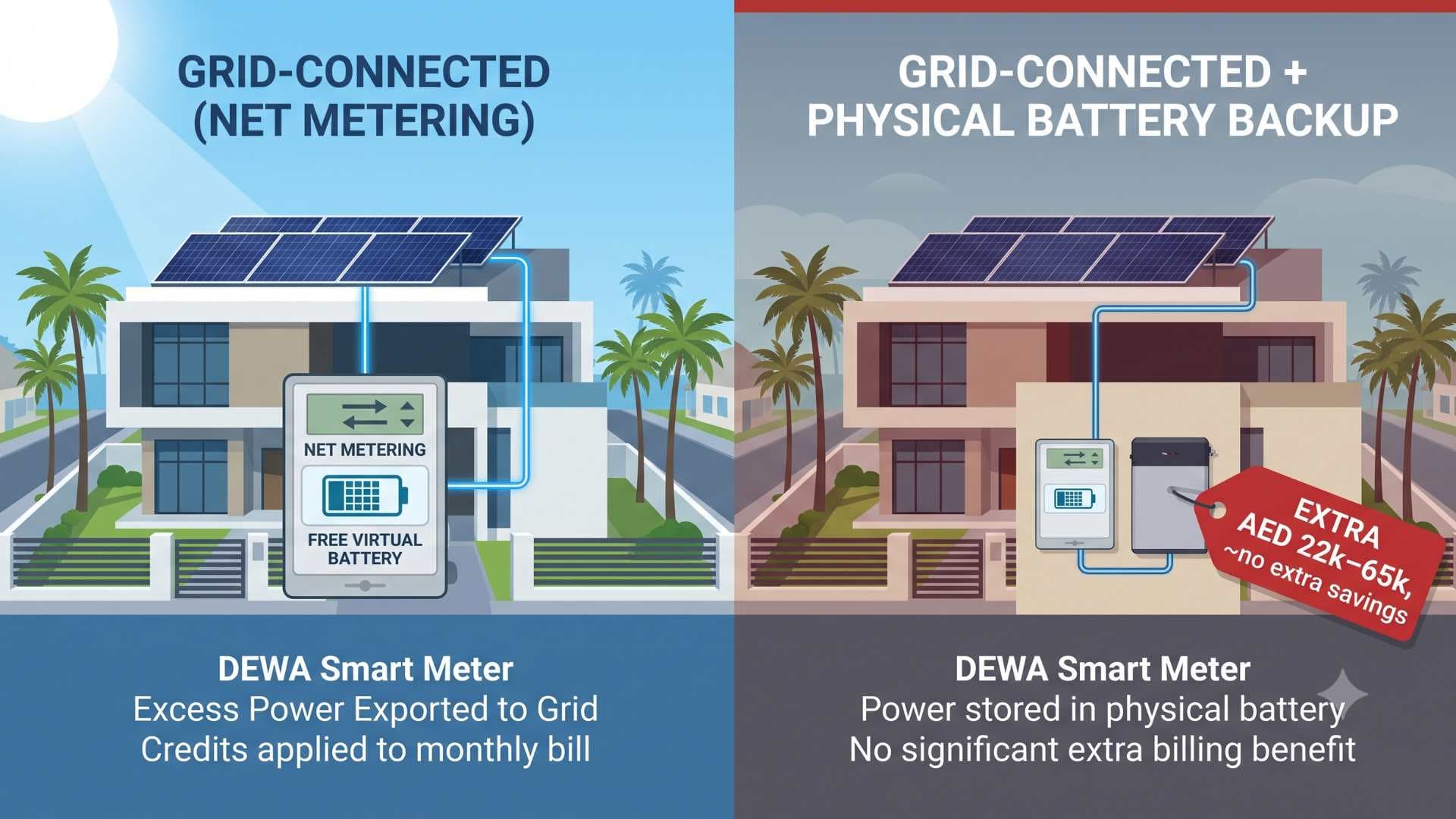
In Dubai, the grid is effectively a free "virtual battery" under net metering — export by day, draw back at night. In Abu Dhabi, that trick doesn't work, because exported energy isn't credited back.
This is exactly why the DoE built storage into the policy from day one — the policy's full name includes "Battery Energy Storage Systems," and Phase 2 explicitly lets customers "store electricity through battery storage systems, substantially reducing pressure on the grid" (DoE Phase 2 release). Khaleej Times summarised the mechanism: customers "directly consume electricity generated on-site during the day and—where approved—use battery storage to extend those benefits into the evening" (Khaleej Times).
This matters most in summer. Alobaidli noted that "in the summer months, Abu Dhabi experiences elevated electricity demand, particularly driven by cooling loads" (Khaleej Times). A villa or business that runs AC hard through the evening can't capture post-sunset solar without storage — so a battery is the tool that turns daytime generation into bill savings you'd otherwise forfeit.
Cost caveat: batteries add meaningful capex. UAE market estimates put home battery storage at roughly AED 2,200–3,100 per kWh, adding AED 22,000–65,000+ depending on capacity (Utility Bill UAE — market estimate, not a verified spec). The economic case in Abu Dhabi is stronger than in Dubai precisely because there's no free grid alternative — but the battery still has to earn its keep against your evening consumption profile.